When we think of running strength, the calves are often overlooked. But if you're a runner—or just someone who wants to stay active and injury-free—your calf muscles are doing a lot more work than you might think.
Let's start at the soleus (one of the deeper calf muscles), one of the hardest-working muscles when you run. Here’s a simple test you can do right now to see if your calves are up to the task—and what to do if they aren’t.
The post covers how to test and train your calves for running strength and injury prevention.
One of the worst injuries I’ve had is a grade-3 left ankle sprain. I was in undergrad at the time and of course didn’t make time for any rehab. We're all invincible when we're 19, right? So now, all these years later, I’m still working to improve my left ankle strength, particularly my lower calf, which often used to cramp early into my runs.
So realize that this type of strengthening isn’t just for a season. Working your strength and “target” areas is a long time commitment.
If you’re having difficulty prioritizing your workouts to avoid injury, that’s exactly what I help runners do in my Return to Run Program. This is a personalized service where I tailor a strength and running program with the goal of helping you recover from injury and chasing your long distance goals.
Now, let’s talk about calf strength:
Why Calf Strength Matters for Runners
Each time your foot hits the ground, your calf muscles absorb and produce force to propel you forward. Weak or undertrained calves can lead to:
👉 Overuse injuries like Achilles tendinopathy or plantar fasciitis
👉 Reduced running economy and slower performance
👉 Compensations elsewhere (think: knee pain or hamstring overload)
For runners, strong calves mean better push-off, endurance, and shock absorption—especially in longer distances or hilly terrain.
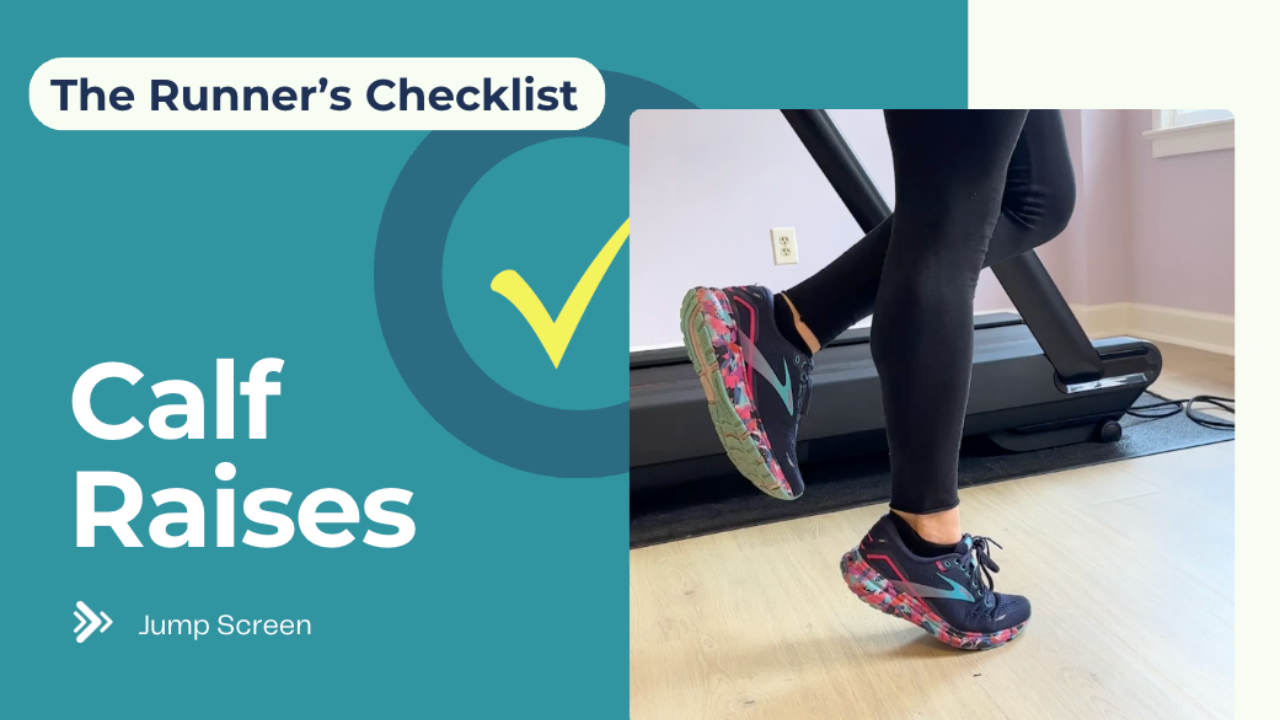
The Test: 25 Single-Leg Calf Raises
Follow this link below for a step-by-step video guide on testing your calf raise.
 |
✅ The Goal:
Complete 25 full-range, controlled single-leg calf raises on each leg. You can mark this as a pass if you can perform without pain or loss of form.
Here’s how to do it:
- Stand on one foot with your fingertips lightly resting on a wall or counter for balance.
- Slowly rise up onto your toes as high as you can.
- Lower down with control.
- Repeat up to 25 times, aiming for full height on every rep.
What to Look For
- Smooth control on both the way up and down
- Knee stays straight throughout the movement
- Equal height compared to the other side
- No pain in the Achilles, heel, or arch
- Minimal use of arms—just a light fingertip assist for balance
- Heel stays centered (not rolling inward or outward)
If you fatigue, wobble, or cramp before 25 reps—or if one side is noticeably weaker than the other—it’s a sign your calves might need some work.
Learn More About Your Calf Muscles
The “calf” is actually made up of two major muscles:
- Gastrocnemius – the more visible muscle on top; works when the knee is straight
- Soleus – deeper and often undertrained; works most when the knee is slightly bent to about 30 degrees (this especially important for runners and walkers!)
Running relies heavily on both—but the soleus does most of the work during distance running, especially when your stride changes due to fatigue.
How to Get Started Strengthening Your Calves
Most runners benefit from doing calf raises 2–3 times a week, especially in off-season or base-building phases. Here’s how to approach it:
▶️ Phase 1: Build Endurance
- Single-leg calf raises: 3 sets of 15–20 reps per side, bodyweight only
- Start on flat ground, and progress to a step for full range of motion
- Focus on full height, control, and no bouncing
▶️ Phase 2: Add Resistance
- Once you can complete 25 reps with great form, add a dumbbell or kettlebell in the hand opposite of your working leg
- Aim for 3–4 sets of 8–12 reps with enough weight to challenge you in the last few reps
- Do this 2x/week, resting at least one day between sessions
▶️ Optional: Bent-Knee Calf Raises
- To specifically target the soleus, perform calf raises with a slight bend in the knee. These are great for runners or anyone rehabbing from Achilles issues.
When to Prioritize Calf Strength
Calf strength is a year-round priority, but here’s when it’s most important:
- Before ramping up training (summer and early fall)
- If you’ve had foot, ankle, or Achilles injuries
- If you run hills or trails regularly
- If you’re increasing speed or volume
And don’t be surprised if your calves feel tight or sore after training. That’s normal when you’re building strength, especially in undertrained areas.
What If You Cramp or Can’t Do 25 Reps?
Calf cramps or premature fatigue usually signal:
- Poor endurance or muscle conditioning
- Electrolyte imbalance or hydration issues
- Lack of regular strength training in that area
Start with shorter sets (2 x 8–10 reps) and build over a few weeks. Stretching afterward can help, but don’t skip the strength work—it’s what your calves really need.
Take the Full Runner’s Strength & Mobility Self-Check
My Runner’s Checklist Course gives you 18 simple, science-backed strength and mobility tests (including this one!)—plus the tools to actually fix what’s limiting you.
You’ll get:
- Guided video walkthroughs
- A 30-page workbook to track results
- A step-by-step plan to build your own warm-up
- Insights that help you train smarter and run longer
If you’re serious about staying injury-free and performing at your best, this is the place to start.
👉 Click here to register for a free sampler of my Runner's Checklist Course. It'll walk you through the five most important tests for running readiness and exercises to address your weaknesses.
I hope you found this article helpful
✉️ Reply to me directly at [email protected] to ask questions about your personal squat form!
❤️🩹 Wondering if it's safe to run while having pain? That's why I made this free PDF download 3-Step Guide to Safer Running. Learn the top questions I ask clients to determine if running is still safe.
Responses