
There's a common pattern you might be experiencing if you have a running injury...
-
You have pain during a run (or several runs).
-
You do all the "right" things: rest, recover, maybe stretch or do some exercises.
-
A few days later, you run again and it feels okay. Maybe several runs go well.
-
Then, seemingly out of nowhere, the pain comes back.
-
Repeat the cycle.
If this sounds familiar, you're not alone.
It's one of the most common stories I hear during consultation calls.
The hardest part isn't always the pain itself. It's what it does to your confidence. Every time you start to think you're finally past it, the pain returns. Eventually you begin questioning every good run, wondering if it's only a matter of time before the next setback.
So why does this happen?
The answer is rarely just one thing. Running injuries are usually influenced by a combination of your training, your strength, your recovery, and your body's current ability to tolerate those demands. That's why there's rarely a simple, one-size-fits-all fix.
One of the concepts we use in sports medicine is called load capacity.
Think of it like developing a callus.
The first time you spend hours raking leaves or lifting weights, your hands might become sore or even blister. But with repeated exposure, and enough time to recover, your skin adapts by becoming thicker and more resilient.
Your muscles, tendons, and bones work in a very similar way.
Running places stress on your body. Given the right amount of stress, enough recovery, and good nutrition, your tissues adapt and become more capable of handling future runs.
That's the entire purpose of training. We don't get fitter by avoiding stress. We get fitter by recovering from it.
Problems arise when the stress consistently exceeds what your body is prepared to handle. That can happen if training increases too quickly, recovery is inadequate, strength isn't keeping pace with your running, or several smaller factors add up over time.
That's when pain often enters the picture.
Take this slide from my Runner's Checklist Course as an example.
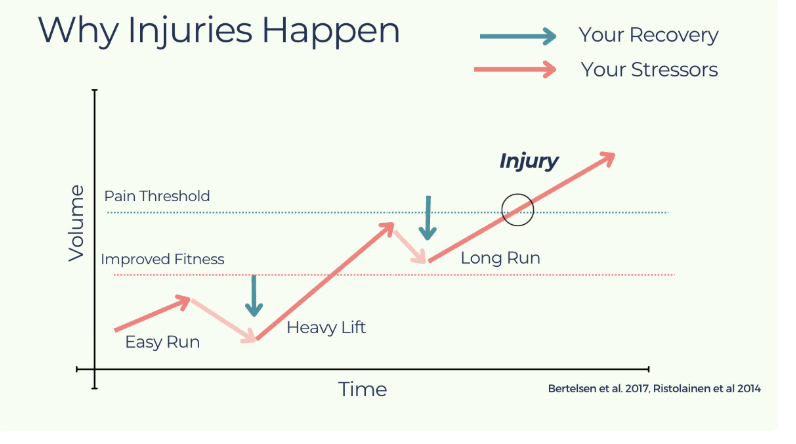
Running and strength training are the stressors that tell your body to adapt. Sleep, nutrition, and recovery are what allow those adaptations to actually happen. When those pieces stay in balance, your body's capacity grows. When they don't, you may repeatedly exceed what your tissues can currently tolerate.
The goal isn't to avoid stress altogether.
Just like you wouldn't want to remove every callus from your hands if you work with them every day, you also don't want to eliminate all loading from your body. A healthy amount of stress helps your tissues stay strong. The key is finding the right amount. Enough to build capacity without repeatedly pushing beyond it.
So if you've tried all the "safe" things like resting, icing, stretching, or random exercises but you still find yourself stuck in this cycle, there may be a missing piece.
This is exactly where many runners in the Return to Run Program started.
If you're ready to understand how to strategically balance your running, strength training, and recovery so you can build confidence instead of guessing what your body will do next, I'd love to chat.
I'm currently offering 15% off the Return to Run Program through August 1st. Reply to this email or book a consultation call to see if it's the right fit for you.
Questions about this topic? Just hit reply to start the conversation.
—
Dr. Erin Kennedy Dalisay, PT, DPT, OCS
Doctor of Physical Therapy & Run Coach


Responses